
New Mexico Department of Agriculture
Metro Institute provides computer-based testing services in New Mexico for the New Mexico Department of Agriculture. Proctored testing sites are located throughout. All persons desiring a Pesticide Applicator license in New Mexico must apply for the license with NMDA before they can schedule any exams
Not registered to test?
If you have not been issued an NMDA Testing ID number or your previous testing application is expired you must apply with the NMDA. Click the button below to visit !
Apply Now!
Already approved to test?
If you have already applied and been issued an NMDA Testing ID number and need to schedule or reschedule a test click the Schedule Now button below. It's fast and easy. Good luck!
Schedule Now
Find a Testing Center
Metro has a testing center network with conveniently located throughout New Mexico. You get directions and print a map.
Click the button to find your location!
Locate
Online CEU's
Metro now offers convenient online Continuing Education Credits in your state! Timely and informative fully approved CEU videos.
Register and start watching!
Get Started!
Testing Info
Everything you need to know to get started.
Testing "Step-by-Step"
Testing Procedure:
1. Apply with NMDA online "Here"
2. Wait to receive your email from NMDA with your testing ID number.
3. Contact Metro Institute to schedule: "Here" or 877-533-2900.
4. Payment of $55 per test may be Check, Visa, MC, AX, or PayPal.
5. Mail checks to Metro Institute, 202 East Earll Drive, Ste 180, Phx, AZ 85012
6. If you cannot make your exam appointment for any reason, you may reschedule at no charge with 24 hour notice. Failure to provide the required cancellation notice will result in the forfeiture of your testing fees.
7. Don't forget: You must bring and present your valid unexpired government issued photo ID to each testing session. You can't test without it!
Schedule a Test Online - "Here"
For support or assistance - Call "877-533-2900"

Helpful Testing Skills
1. Depending on the exam you will have 1 to 2 hours to complete it . Most people complete a test in approximately have the allotted time. Therefore, take your time and read each question and each of the possible answers very carefully.
2. You may skip questions and return to them later. You may review any or all of the test as long as you have time remaining on the clock.
3. Most tests have 50 questions and you must answer 70% correctly to pass. For instance, on a test with 50 questions you could miss up to 15 questions and still receive passing score. However, if you miss 16 or more questions you will receive a failing score and then must re-schedule to take the test over again.
If you have any technical issues or questions regarding the testing interface notify the proctor for assistance. The test proctor cannot discuss test questions or provide any help with test content.
Study Materials
After the Test, What Next?
Passed the Test?
1. If you passed all the exams you were approved for, follow the instructions for your specific license type.
- Operator/Technicians: Print your score sheet and mail it to NMDA with the $50 license fee.
- Commercial Applicators: Print your score sheets and mail with your insurance certificate and $75 license fee to NMDA.
- Public Applicators: Print your score sheets and mail a copy to NMDA. Your license will be printed and mailed to your agency.
- Noncommercial Applicators and Pest Management Consultants: Print your score sheets and mail with your $75 license fee to NMDA.
2. If you passed the “Core” and at least one “Category” exam, you can get your license with only that category. Email NMDA at pesticides@nmda.nmsu.edu and notify them that you want your license issued without the categories you failed or did not take.
Reviewing Test Scores
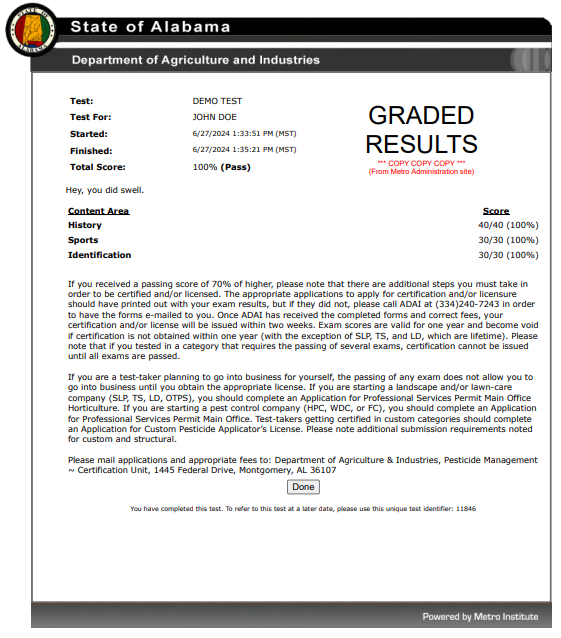
When you complete your test, be sure and print your score sheet. You will be prompted by the computer to do this at the end of your testing period.
If you passed your test, the score sheet is your written proof that you have passed that specific exam. Please review the BOLD text on your score sheet for licensing information.
Failed the Test?
If you failed one of your exams, you may re-take that exam. However, you may not take the same exam more than once on the same business day. Don’t forget, you must complete ALL the licensing requirements in 60 days, or you’ll have to start over. Reschedule online at Metrosignup.com
For Technical Support, Assistance, or Questions call 877-533-2900
What to Expect at the Testing Center
Metro strives to provide a professional and pleasant testing experience for every examinee. Below you find some simple requirements and rules to follow before, during and after your exam. Not everything is covered here and your exam proctor may advise or remind you of the rules to begin and finish your exam.
Good Luck and thank you. If you have any questions or concerns regarding testing rules and procedures please call Metro Institute toll free at (877) 533-2900
Photo ID Required
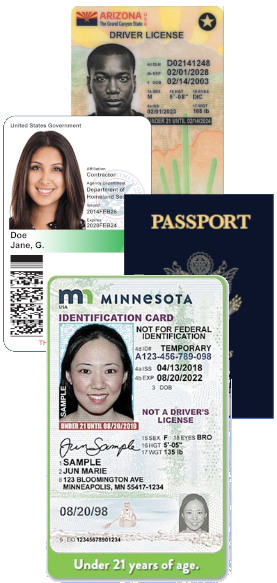
A test candidate must present to the test proctor a government- issued photo identification:
Acceptable ID includes original, unexpired, current photographic identification that clearly depicts the examinee, and is obtained from a governmental agency.
Examples include a state driver’s license, military identification, passport, state-issued identification card, or federal agency identification.
You will not be able to test without a qualifying ID.
Items Not Allowed in Testing Room
Examinee Personal Items
Maintaining exam integrity is one of the primary goals of a proctored exam. One of the ways exam integrity is achieved is by limiting the items allowed in the testing room. The method used to store personal items can vary by testing center. Examples of storage methods are: lockers, storage containers, or asking examinees to leave unnecessary items in their vehicle. All testing centers must provide some form of secure storage for car keys and other small items.
Items Not Allowed in Testing Room:
(This list is representative but is not exhaustive. Other items that are deemed to cause distraction to other examinees or put exam security at risk may be prohibited)
- Watches, smart glasses, fitness devices (e.g., Fitbits), cellphone, backpacks, purses, wallets, bags, sunglasses, food or drink, loose change, personal scratch paper, trading aids, pencils, pens, tissues, hats, earmuffs, scarfs, umbrellas, medications (inhalers or diabetic items are exceptions), personal laptops, keys, and work ID badges
- Regarding outerwear, coats and jackets should be stored or hung up outside of the testing room. Exception: Some vendors allow jackets to be placed on back of testing chair.
Items to be VISUALLY checked before an examinee is seated
• Glasses - Proctor must visually inspect the glasses of examinee.
• Jewelry - Solid or chunky jewelry must be visually inspected. Items that may cause noise or distraction must be removed.
• Pockets - Pockets of examinees must be emptied with all items placed in a locker or storage area. Examinees must be asked to pat their pockets to show all items have been removed. Some testing centers require that pockets be turned inside out.
(Please note: The proctor should never physically touch the examinee to determine that pockets have been emptied. This should be determined by visual inspection only.)
Other Considerations: • Backpacks - rolling or large bags that do not fit in storage area should be stored in vehicle. If that is not possible, it is recommended that valuables be removed and secured in the locker or storage area. Backpacks must be placed at a designated location with the understanding that the examinee is liable for any belongings. Examinee’s personal belongings must never be stored in the proctor area.
Examinee Disqualifications
All incidents (cheating, distraction, noise, unscheduled breaks etc.) will be reported as defined in processes below. Suspected cheating behavior on exams should be verified by at least two center staff persons whenever possible before action is taken.
• Examinees will be disqualified for cheating.
• Cheating includes, but is not limited to, copying questions or answers in any manner, talking with other examinees, referring to any notes while the exam is being administered, or being in possession of any items with documented questions, answers or notes or any other restricted materials.
• When an examinee is disqualified the exam will be terminated and the examinee will be asked to leave the testing center.
• The proctor should collect and retain any evidence or items relevant to the incident such as notes, study material or devices.
Incident Handling: All disqualifying incidents (cheating, distraction, noise, unscheduled breaks etc.) will be reported to Metro Institute and the governing agency.
• Metro will immediately notify the Agency Compliance Officer for incident review, penalty review and penalty enforcement as allowed by rule, regulation and law.
For customer service or technical support call (877) 533-2900
LET METRO HELP MAKE YOUR TESTING EXPERIENCE WONDERFUL AND SUCCESSFUL!
©
2026
Metro Institute Inc. Metroinstitute.com
Powered by Metro Institute MOS iCBT 3GB